

Clear Aligner Treatment Guide: Common Questions and Answers
Clear Aligner Treatment
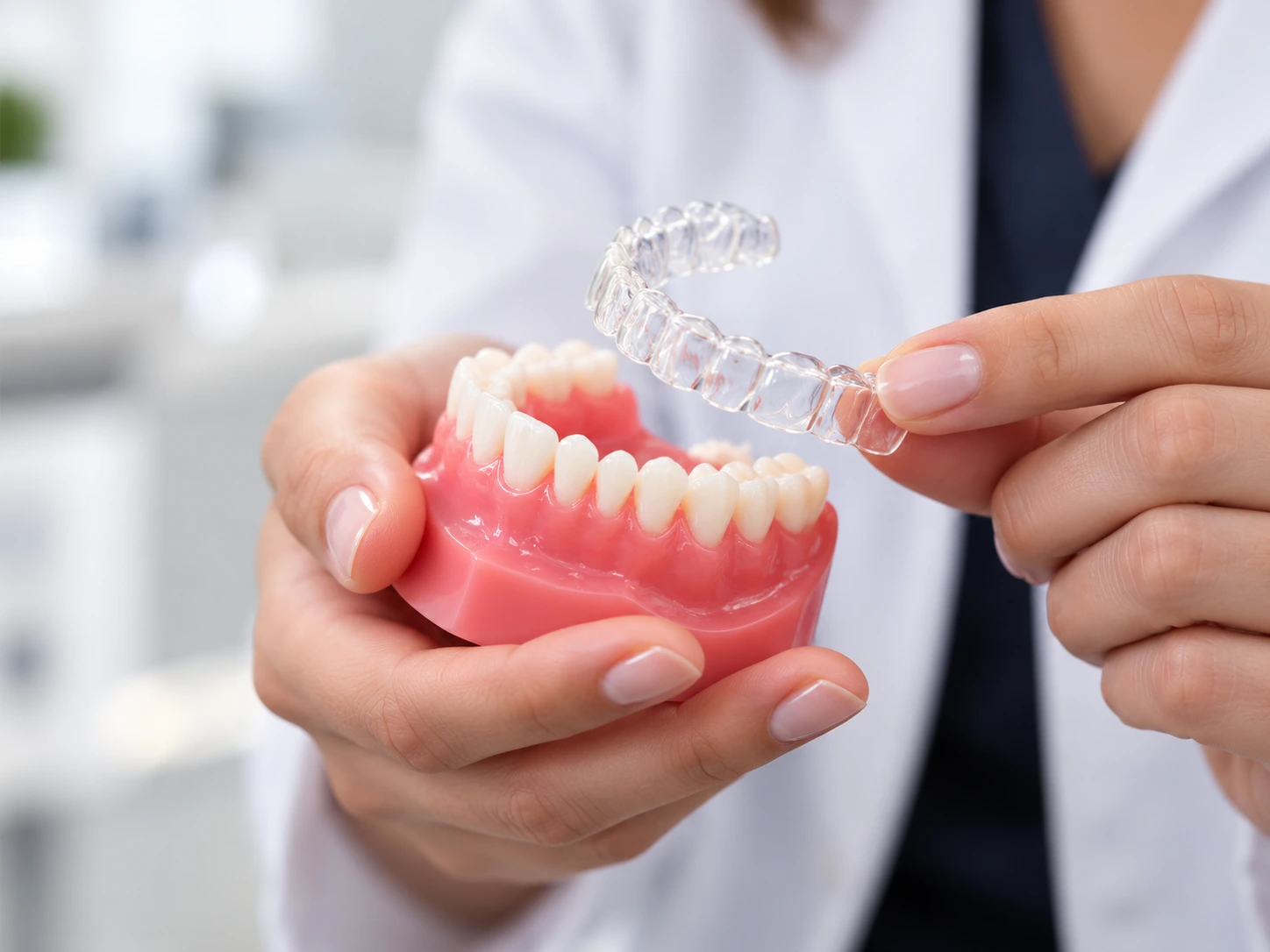
Clear aligners are removable orthodontic aligners created through individualized digital treatment planning. In this guide, we cover the key topics patients commonly ask about, from how clear aligners work and their advantages to who may be suitable for treatment, treatment duration, daily wear and the differences between Invisalign and conventional braces.
Common Questions About Clear Aligner Treatment
What are clear aligners?
Clear aligners are thermoplastic orthodontic aligners individually prepared as an alternative to wire-and-bracket systems in order to move crowded teeth or teeth whose positions are planned to be changed.
A series of aligners precisely adapted to the patient’s mouth is created using three-dimensional digital impressions. Each aligner is designed to carry out a specific part of the tooth movements determined in the treatment plan.
During digital planning, the treatment plan created by the clinician is modelled in a three-dimensional environment. This allows the positions of the teeth at different stages of treatment and the intended outcome to be evaluated digitally. Once the plan has been adjusted and approved by the orthodontist according to the treatment goals, the manufacturing stage begins.
The manufactured aligners create controlled areas of pressure on the teeth, allowing the planned tooth movements to occur gradually. The direction and amount of force are determined individually according to the required tooth movements and treatment plan.
What are the advantages of clear aligner treatment?
Clear aligners are among the frequently preferred orthodontic treatment options because of their discreet appearance, removability and the convenience they may offer in daily life compared with conventional wire-and-bracket systems.
Planned tooth movements can be calculated three-dimensionally in a digital environment. This may make it possible to review the planned final positions of the teeth and the treatment process together with your orthodontist before treatment begins.
Their removable design also provides an important advantage in terms of oral hygiene. Brushing the teeth and cleaning between them can be performed more easily than during treatment with fixed brackets and wires.
Because the aligners are removed while eating, some of the restrictions involving hard foods that are encountered with fixed wire-and-bracket systems do not apply in the same way during clear aligner treatment.
The smoother surfaces of the aligners may also help reduce the mechanical irritation that brackets and wires can cause to the cheeks or lips.
In addition, emergencies specific to fixed orthodontic systems, such as broken brackets or protruding wires, are less common with clear aligner treatment. In suitable situations, the ability to monitor certain stages of treatment remotely may also provide convenience in everyday life.
The removable design may also make daily activities easier for people who participate in sports. Similarly, the low visibility of the aligners may be one reason they are preferred in social or professional settings.
Who may be suitable for clear aligner treatment?
Clear aligner treatment may be considered for a broad range of patients, from childhood through adulthood, once an accurate diagnosis has been made and an individualized treatment plan has been established.
Some clear aligner systems used during the primary and mixed dentition stages may be incorporated into the treatment plan to guide the development of the dental arches and to create space for erupting teeth in cases where space is limited.
In growing children, functional features of clear aligner systems may be used to assist with arch expansion or to guide certain jaw relationships. Where necessary, treatment may also be planned using conventional functional appliances together with clear aligners.
In adult patients, there is no absolute upper age limit based solely on age. Clear aligners may particularly be used as part of an orthodontic treatment plan when teeth need to be moved into more appropriate positions before comprehensive prosthetic rehabilitation.
If gum disease, bone loss or other periodontal problems are present in older patients, the supporting tissues should be assessed in detail before orthodontic treatment begins.
Ultimately, suitability for clear aligner treatment should not be determined by age alone, but by the health of the teeth and surrounding tissues, the bite relationship, the jaw structure and the orthodontic movements that need to be achieved.
How long does clear aligner treatment take?
The duration of clear aligner treatment may vary depending on the severity of the patient’s malocclusion, the treatment goals, the planned tooth movements, individual treatment compliance and the aligner system being used.
Because the number of aligners required and the tooth movements to be carried out differ from one patient to another, it would not be appropriate to give a standard treatment duration that applies to everyone.
For some orthodontic problems, the mechanical and digital planning possibilities provided by clear aligners may help the treatment process proceed efficiently.
However, which orthodontic problem can be treated more effectively or within a shorter period using a particular system should always be determined by the orthodontist after a detailed clinical assessment.
Is clear aligner treatment better than braces?
The use of clear aligners in orthodontics is not a new concept. In the 1940s, Dr. Harold Dean Kesling worked with removable clear appliances for simple tooth movements.
One of the important milestones in the development of modern clear aligner systems occurred when Align Technology combined clear aligner treatment with computer-aided design and manufacturing technologies in the late 1990s.
While early-generation systems were capable of performing more limited orthodontic movements, the range of applications for clear aligners has expanded considerably over time with developments in software, materials and digital treatment planning systems.
Nevertheless, conventional bracket-and-wire systems remain an important part of contemporary orthodontic practice and continue to be widely used.
For this reason, rather than comparing the two systems only by asking which one is “better,” it is more appropriate to evaluate the patient’s specific orthodontic needs.
Successful results with either system are closely related to an accurate diagnosis, an appropriate treatment plan, clinical follow-up by the clinician and the patient’s compliance with treatment.
Clear aligners may offer advantages such as aesthetics, comfort and removability. However, the system that is more appropriate for you should be determined through an orthodontic examination and according to your individualized treatment goals.
Are clear aligners used only for simple tooth movements?
With the development of clear aligner technology, their use is no longer limited to simple tooth-alignment problems.
In suitable cases, clear aligners may be included in treatment plans for different malocclusions such as open bite, deep bite and crossbite.
For some orthognathic surgery patients who do not wish to use braces, orthodontic preparation before and after surgery may also be considered using clear aligners.
Some of the functional approaches traditionally used to guide growth and development in children are also being integrated into modern clear aligner systems.
However, in certain cases requiring more comprehensive functional jaw orthopaedics, a combination of conventional appliances and clear aligners may be preferred depending on the child’s stage of development and treatment goals.
For this reason, rather than following a standard treatment protocol for every patient, an individualized treatment plan should be established after a detailed orthodontic examination.
How should clear aligners be worn?
Once clear aligner treatment has been chosen and the individualized sets of aligners have been manufactured, the order in which the aligners are worn and the interval between changes are determined by the orthodontist.
Depending on the treatment plan, each aligner may generally be changed at intervals of approximately one or two weeks.
For the planned tooth movements to occur, the aligners generally need to be worn for approximately 22 hours a day.
Aligners are primarily removed while eating and during oral hygiene. The patient’s daily wear time and aligner-change schedule should be followed according to the individualized treatment instructions provided.
Wearing the aligners for less than the recommended period or changing the sequence based on personal judgement may affect the tooth movements planned for treatment.
How are clear aligner treatment costs determined?
One of the important factors affecting the cost of clear aligner treatment is the system and manufacturing technology being used.
The properties of the aligner material, the manufacturing process, the digital treatment infrastructure and the extent of the orthodontic problem all play a role in determining the overall treatment plan.
Although different clear aligner systems may appear similar externally, their material properties, manufacturing methods and digital planning infrastructures may differ.
Global clear aligner systems such as Invisalign have been developing digital planning and manufacturing technologies for orthodontic treatment for many years.
As clear aligner treatment has become more widespread, treatment options and cost structures have changed compared with previous years. However, it is not possible to provide a single fixed fee that applies to every case.
The extent of the orthodontic problem, the number of aligners required, treatment duration, the system used and any additional procedures that may be necessary can all affect the cost.
For this reason, the most appropriate way to determine an individualized clear aligner treatment plan and the related cost is after an orthodontic examination.
Why is proper planning important in orthodontic treatment?
Orthodontic treatment is not simply about aligning the teeth for aesthetic reasons. The positions of the teeth and their roots, gum and bone health, the relationship between the jaws, function and smile aesthetics are all parts of the same treatment plan.
When choosing between clear aligners and conventional orthodontic systems, attention should be given not only to the material or appliance being used, but also to the diagnosis, the treatment plan and the clinical assessment of the clinician managing the process.
A detailed assessment by an experienced orthodontic specialist is important in determining the treatment method that is appropriate for you.
Is clear aligner treatment suitable for you?
Whether clear aligner treatment is suitable for you is determined by evaluating the current positions of your teeth, your bite relationship, gum and bone health, age, treatment goals and the planned orthodontic movements together.
You can contact our clinic to learn more about individualized orthodontic assessment and available treatment options.
This content has been prepared for general informational purposes and does not replace a clinical examination, diagnosis or an individualized orthodontic treatment plan.
For treatment-focused information about Invisalign and clear aligners, visit the Invisalign treatment page.